
My Favorite Hack for Science in Our Homeschool
I have a secret to share, I’m the co-op science teacher, even earning the name Mrs. Science Teacher, but at home, I have a horrible track record for doing science experiments with my kids. It can be a lot of work to set up an experiment only for it to go wrong. It’s not how I want to spend our homeschool days. The latest updates to the Sonlight Science curriculum make it easy to follow through on the doing which is just the help I need.
We have loved Sonlight for a long time. Their elementary readers are one of the few things that worked for all three of my kids. Their science curriculum is something we have used on and off for many years as well. I really like science books that Sonlight pulls together for each year to give us a variety of fun topics to explore.
I have been guilty of skipping the scheduled experiments for years but I don’t stress out too much because the experiments support the scheduled reading and we can watch someone else do it on the Discover and Do DVDs. The core of Sonlight Science is great books The experiments provide additional hands-on learning. As a mom with ADHD, I struggle with the preparation and supply-gathering part of the experiments, as well as the cleanup. The experiments we do make time for are always worth our time.

2023 Sonlight Science Updates!
In the latest updates to the Sonlight Science Levels (Levels A-F are updated as of 2024), its even easier to do the experiments because the new Discover and Do Science Experiment Books help you every step of the way, and the Supply Kit gives me no excuse because more of the supplies are included with the curriculum. The instructions for each experiment in the Discover and Do book tell me exactly which supplies are in my Kit and which ones I have to find in the house.
Experiments are still scheduled to be done weekly and are introduced with an inquiry question which the activity will explore. Key concepts and background are included in the activity so I can be confident about how it fits in with what else we have read during the week and help my students make connections from the readings.
Building Science Lab Skills
In the Discover and Do Experiment books. Each work text includes the lab information and worksheets in the same book. Additional Experiment Paper Packs are available for additional students. Students are introduced to a traditional lab report process as they complete each experiment with each of the steps of a scientific method included
- Topic Introduction
- Make a Prediction
- Investigate
- Draw Conclusions
- Takeaway
- See the Bigger Picture
- Go Further
In each of the sections of the activity we as a family are guided to follow our curiosity and ask questions and explore together. Each experiment has worksheets to use for planning your experiments or recording data depending on the project. I like how simple the layout is for these pages and my kids who struggle with handwriting have plenty of space to write and change their plans.

Sonlight Science In Our Homeschool
On our experiment days, the first thing I do is grab the Discover and Do book and use the handy codes to find which materials to grab from our supply kit and which ones to grab from the rest of the house. We are using Sonlight Science Level E with my 6th grader.
Today we are doing Experiment 9, “Can Matter Be Invisible? From around the house, I only need to grab a drinking cup, spoon, water, scissors a ruler, and colored pencils. These are all easy-to-find things in our house. I can even send my kids to gather them up while I make sure the table is cleared of other materials.
The second step we do is to review the concepts being learned this week. Sonlight does a great job of weaving together multiple texts during the week so we learn in different ways. We reviewed what they learned from How to Be Good at Science, Technology, and Engineering and also read through the Key Concepts and Introduction in the book. The Introduction ends with a few questions which helps us get curious as we begin our experiment and start to investigate.
As we follow the experiment procedures in our book, we record our predictions and data on our worksheets. I like that there is plenty of space to write which some of my kids need due to their dysgraphia. For this experiment, there are 4 different models we will be looking at as we study the three states of matter.
The question that stumped us in this experiment was, Did the air in a balloon have particles of matter? Quantifying the properties of air can be a challenge for our students since we can’t see or touch it in the same way as marbles or sugar granules. This experiment helped us see it in a concrete way.
After we investigated all 4 Models we were able to have a discussion about why each one worked the way it did. We were able to talk about mass vs weight and if something has weight it has mass. In the last section of each experiment in the book, is the takeaway. In this section we circle back to our initial question and the text helps us summarize what we observed and give us the science words to explain it.
There are also Big Picture connections that help us apply what we learned to things we see around us in everyday life. The Go Further section gives ideas for more experiment options and ways to test the concepts. If you are using these experiments with a wide age range these experiments would be a great way to scale up the activity.
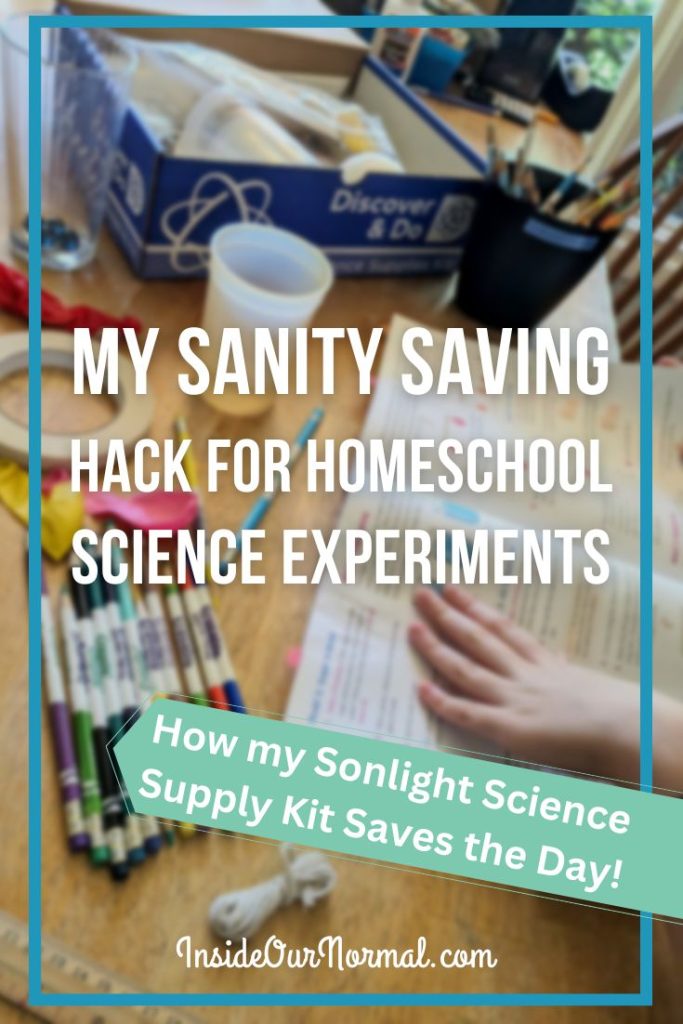
Hands-on Science for the No-Prep Mom
While we did most of the experiment together, the instructions were clear enough that my 6th grader could finish it up independently while I helped their brother with another activity. He even cleaned it up and put away the supply kit until we were ready for next week’s experiment.
Once again Sonlight proves it understands homeschool families and makes our job as teacher-parents easier with the new Discover and Do Science Experiment Books. My planning is easier with the supply kit and my student is empowered with the easy-to-follow directions and lab reports to record their thoughts.
Each level of Sonlight Science covers a group of topics so you don’t have to worry about getting bored. We have even been known to do different sections out of order some years to follow their interests. If you aren’t sure of the right fit for you. You can check out samples of all the levels on their website to find the right one for you!